
Principles for Living Fully: Embracing Your Inner Sisyphus

Hi Team, Tara here!
Over breakfast this morning my husband—currently deep into Albert Camus’s The Myth of Sisyphus—lobbed a deceptively simple question my way: “What gets you excited to get out of bed every morning?”
My husband was challenged by Camus’s claim: the universe is absurd - it offers no ready‑made meaning, no divine score‑card. If life is logically empty, my husband wondered, how do we decide what should matter?
“The struggle itself toward the heights is enough to fill a man's heart. One must imagine Sisyphus happy.”
Albert Camus, The Myth of Sisyphus
A 60‑Second Sisyphus Primer
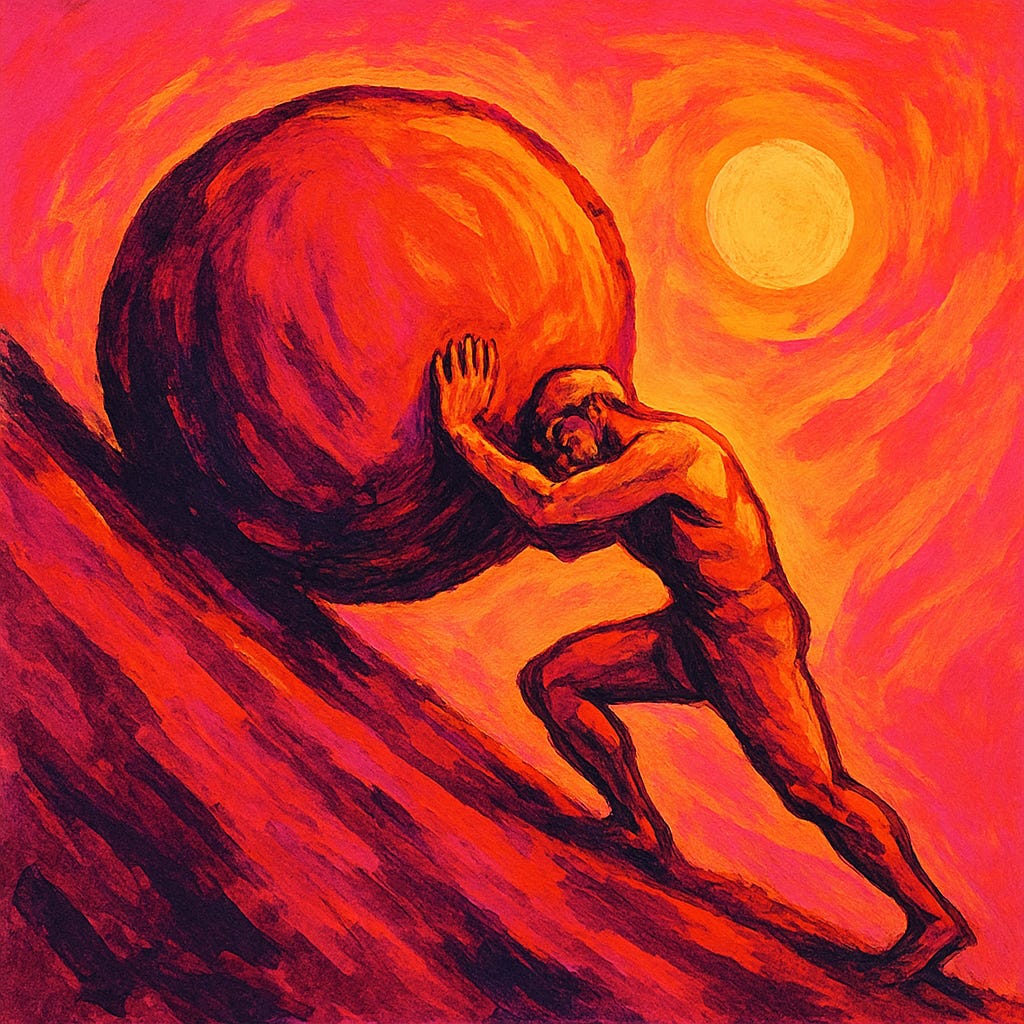
Sisyphus is a figure from Greek mythology condemned to push a giant boulder up a hill—only for it to roll back down each time he nears the top. On repeat. Forever. His punishment screams pointless.
Camus flips the script: suggesting Sisyphus isn’t miserable at all. Maybe he finds meaning not in reaching the peak but in choosing how he pushes. Happiness is carved out of the climb, not the summit.
That idea hit home. Many of us chase the best life—salary bands, titles, Instagram‑worthy milestones. But what if the real metric isn’t best living, but most living? More texture, more aliveness, more deliberate struggle.
Principles are how we decide what that most looks like—and how we stay true to it once the slope steepens.
Camus’s defiant image of Sisyphus—eternally heaving his boulder yet choosing happiness—gives us a radical reminder:
Life’s worth is not measured in successful summits but in the vigor of the climb.
It made me think how do I define for myself and my life: what adds texture and aliveness? What are my guide posts for navigating an unbounded world? What gives meaning, happiness and peace to my life?
I wasn’t sure what the answers were upfront, but where I started to unpack revolved around defining my personal values & principles. My mind wandered to a few people who have well articulated principles that they iterate on and live by:
Ray Dalio | “Pain + Reflection = Progress.” He institutionalized radical transparency at Bridgewater, recording meetings so truth supersedes ego. Result: a culture where feedback feels like oxygen, not criticism. He published his principles in his book, Principles.
Charles Munger | Champions a latticework of mental models. Principle: cross‑disciplinary curiosity beats siloed expertise. Munger reads everything from genetics to ancient history—edge in investing, yes, but also in empathy.
Brené Brown | In her book Dare to Lead, Brown converts vulnerability into a leadership principle: “Clear is kind.” Saying the awkward truth early saves months of silent resentment.
What is a Principle?
Principles are your personal settings—core, non‑negotiable values that steer thousands of micro‑choices each day.
Actionable. A principle tells you what to do next: “Default to generosity,” “Protect deep‑work mornings.”
Context‑proof. Whether you’re job‑hunting or negotiating daycare pickup, the principle still holds.
Long‑lived. Goals expire; principles endure. “Ship an MVP every Friday” outlasts any single launch.
In my new year’s post I mentioned three pillars I wanted to explore this year: creativity, connection and awe. While I didn’t fully craft my principles at breakfast today, some ideas that I floated around included:
Protect space for creativity. Whether it’s writing, painting, or brainstorming with a fresh mind—creativity doesn’t happen without boundaries to protect it.
Invest in meaningful relationships. Prioritize presence when it comes to people I care about.
Seek awe on purpose. Build time into the week to experience something that shifts perspective—whether that’s a hike, a performance, or a story that stirs something bigger than myself.
When you accept, with Camus, that life comes with no pre‑installed purpose, everything can seem equally pointless—analysis paralysis at cosmic scale. Principles can solve the paradox. By choosing them, you decide which moves matter more than others. In that act of authorship you manufacture meaning for yourself each day.
Craft Your Own Principles
Spot the Sparks. Scroll your calendar, journal, or camera roll for moments that lit you up. Capture the verbs (“built,” “mentored,” “explored”)—they point to your core values.
Turn Values into Verbs. Convert each value into a punchy command: “Default to generosity,” “Protect deep-work mornings.” If it can’t finish the sentence “When in doubt, I will …”—rewrite it.
Pressure-Test. Drop a recent dilemma onto each draft principle. Would following it still make you proud tomorrow? Keep what passes; tighten what wobbles.
Ship, Then Iterate. Post your top three where you can’t miss them—laptop lid, phone lock screen. Revisit them: keep, tweak, or retire. Old principles aren’t failures; they’re growth snapshots.
P.S. Once yours feel solid, run the same sprint with your partner or team—shared principles beat silent expectations every time.
Your Call to Climb
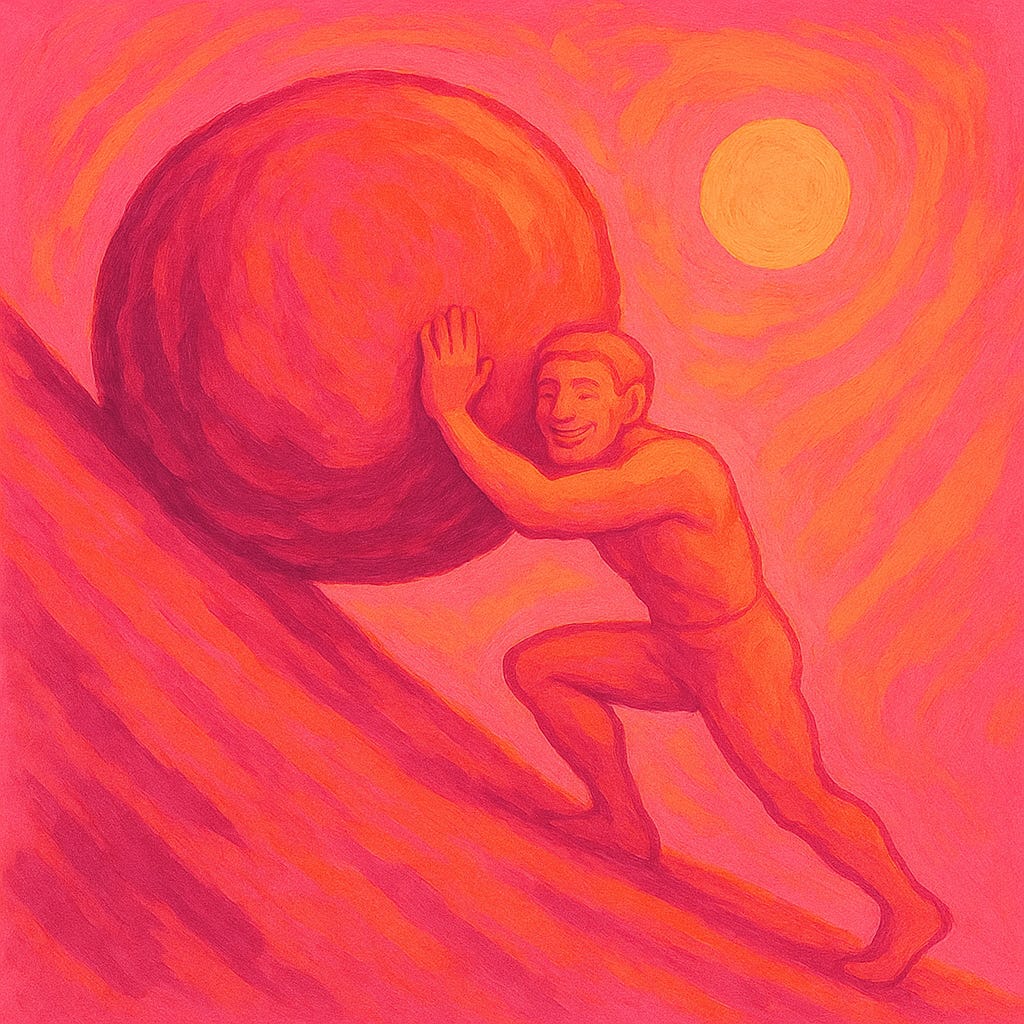
Sisyphus’s rock is inescapable. Ours might be product deadlines, long commutes, or relentless Slack pings. But the choice to push with purpose—and to sculpt principles that make the push meaningful—belongs entirely to us.
This week, reply and share one principle you stand by. And if someone forwarded you this newsletter, you can subscribe here. The climb is lighter together.
Keep striving, keep shaping, and imagine yourself—rock and all—undeniably, unreasonably happy.
Tara